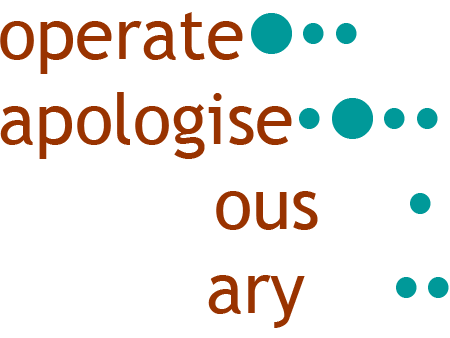
In their study, Murphy and Kandil (2004) run an analysis on
the Academic Word List (Coxhead , 2000) to categorize stress patterns. Their
aim, I believe, was to determine which word-stress patterns were the most
common, and thus help instructors focus their efforts on teaching those
particular patterns. They developed a numeric convention to group words by
their common stress patterns: 3-2 means that a word with three syllables would
have its primary stress on the second syllable (e.g. commitment); 5-3-1 would
be a word with five syllables, the primary stress being on the third syllable,
and a secondary stress on the first syllable (e.g. theoretical). The results of
their analysis shows that of the 525 headwords in the AWL, there were 39
distinct patterns, but over 90% of these words have only 14 of those
word-stress patterns. Looking at their results table (p. 69), we see that the
most common stress pattern is the 3-2 pattern, followed by the 2-2, 4-2, and
2-1 patterns. They conclude that knowing these patterns “should prove useful as
a complementary source of information for purposes of curriculum and lesson
planning and private study” (p. 73). In addition, they state, “[W]e have found
that the numeric conventions for labeling stress patterns illustrated in this
report are useful when working with EAP and other ESL learners” (p. 70).
As
practitioners, rather than researchers, how do we apply findings like this?
First of all, let us look more closely at these patterns and real examples that
we would use in the classroom. For the 5-3-1 stress pattern, which was
mentioned in the article along with the sample words theoretical and methodology,
these two words are grouped together because they each have five syllables and
a primary stress on the third syllable. But how about the word electrical? That is a four-syllable
word, with its primary stress on the second syllable (4-2), so thus would be
placed in a separate category, despite the fact that it shares an important
attribute with theoretical, a 5-3-1.
Also, we have biology, another 4-2
word, placing it in a category with electrical,
rather than with methodology.
This wouldn’t make a lot of sense to instructor and student alike. And how
would teaching a numeric convention along with the word and its meaning be of
much help except for a student who is adept at numbers and wants to memorize a
3-2 along with the word?
Perhaps
theory has caught up with practice in the years since this study was published.
One of my favorite pronunciation resources is Well Said: Pronunciation for Clear Communication (Grant, 2010). Her
chapter on “Using Suffixes to Predict Stress” introduces the idea that
word-stress is often based on suffixes, and contrary to Murphy and Kandil’s
method of counting from left to right, her rules are based on right to left. It
doesn’t matter how many syllables the word is, most common suffixes call for
stress on the syllable right before the suffix. Or perhaps the second syllable
from the suffix (again, starting with the last syllable). Here are some
examples, showing that the numeric convention is less helpful than simply
knowing the suffix:
- ic
scientific (4-3)
electric (3-2)
economic (4-3)
- ion
information (4-3)
imagination (5-4)
institution (4-3)
- ology
biology (4-2)
psychology (4-2)
epistemology (6-4)
Here we can see that helping
students notice that in general, the suffix usually calls for the primary
stress to be just before it may be more helpful than grouping words based on
total syllable counts, the way that Murphy and Kandil describe. It should be
acknowledged here that they did mention in their discussion the fact that
suffixes have an impact on stress. Specifically, they write, “[T]eachers may
take advantages of the opportunity…to build learner awareness of the impacts of
suffixation by also introducting stress patterns of related words within the
same lexical family (e.g. eCONomy, ecoNOMical, ecoNOMically, and eCONomist)”
(p. 71). But they fail to see that knowing which suffixes call for the stress
immediately before and which do not (e.g. ic/ical vs. ist) is probably more
than the importance of words being within a certain lexical family.
I certainly agree, however, with
the article’s premise that word-stress patterns are a very important aspect of
pronunciation, especially in the realms of EAP and academic preparation.
Teaching word-stress patterns, especially with suffixes, can be fun and
engaging while lending itself well to various academic topics.
References
Murphy, J. & Kandil, M. (2004). Word-level stress
patterns in the academic word list. System,
32, 61-74.
Grant, L. (2010). Well
Said: Pronunciation for Clear Communication. National Geographic Learning.